Days 4,423-4—the Mohican 100! My First Ohio 100-Miler: Through Mud, Hills, Raccoons, and the Enchanted Forest—

Start time: 5:00 a.m.
Weather: 50s-70s, wind 5-10 mi/h, Humidity 83%
The Mohican 100 Part: Before the Race
The drive time prediction on my phone was for 7 and a half hours, give or take 30 minutes. Including stoppage time, it took me 9 hours to make it to Mohican Adventures Campground and find my campsite. The roads were winding at the end, and I noticed that the area was about 30 minutes away from civilization. I walked to packet pickup. It was close, but I had to pass a busy road to get there. They found my name immediately and handed me a plastic bag. I walked back to my campsite and found someone setting up next to me. Because they were traveling alone, I assumed correctly that they were here for the race like me.
A little after 7 p.m., we walked over to the information meeting together. She told me she was planning to run her first 50-mile race tomorrow, and before this, she had only hiked. She said for the past several years she has done a 100-mile hiking trip in a national park. She recently talked about hiking in the Grand Teton. I thought about how hikers, in many ways, are doing it the right way because they have more time to experience the environment and take pictures. Running is much better than driving, but you miss a lot more when you run than when you hike. It was satisfying to drive there, park, and not have to use my car again until the next morning. I bought a blow-up armchair that I relaxed in before bed, watching TV on my VR headset. I was determined to create the hotel experience in my tent.
I woke up several times before morning. I went to bed, leaving a lot still not done, and I only had an hour before the race started at 5 a.m. Ohio is an hour behind my time in St. Louis, so for me it felt like getting up at 3 a.m. for a 4 a.m. start, with no coffee and only 5 hours of sleep. I managed to get up and drive my coolers down to the start/finish. Set up my area next to a picnic table. Driving my car back to my campsite, using the bathroom, and walking to the start of the race.
10 Minutes Before the Start of the Race
I sat down on a picnic table and felt relaxed because I made it in time. The guy next to me recognized my voice and said that he had watched my Potawatomi race video! He said that he tried my technique with the overshoes, but they were too small. I felt bad because I ran into this problem too, but I bought a larger pair after trying the one I initially used. Still, he said he ran 150 miles, that’s a tough course, but it was nice to hear from someone who watched the video that I didn’t know, and so random, I was sitting next to him at the start of this race. He said he was going to enter the Western State lottery.
5 Minutes Before the Start of the Race
The guy started talking, making the regular announcements about how much time we had left.
“Perfect conditions today! The finishing rate should be the highest ever! So please, everyone, finish!”
It was in the mid- to high-50s at the start of the race. The warmest it got was in the 70s, and the coldest was in the high 40s. The temperature was ideal, and this was my 4th straight race with similar conditions, ideal for running. What I find remarkable about ideal weather conditions is that they don’t seem to make much difference in how many people finish the race. My theory is that when the weather is too nice, it can cause runners to take unnecessary risks and get dehydrated, so it might be the best weather in theory, but it usually doesn’t benefit all runners.
The MO 100
Start Time: 5 a.m.
Date: 5/30/26
Number of Runners: 200
Temperature: 50s-70s
There was a huge crowd of runners when we started. I remember the videos I watched, both runners complained about the huge line of runners walking up the hills, likening it to a giant congo line. At first, I was determined not to let it bother me if I ended up walking a lot at first if I got caught behind a bunch of other runners at the start, but when it happened, I started to get frustrated.
There were some people around me who were friendly and talking. One guy who told me his name but gave it only with the condition that this was his “government name,” I think his name was Adam. He was running with a couple of others who were determined to keep their pace roughly the same for most of the run. This was a strategy I have never tried, and it doesn't make a lot of sense to me. For me, however fast I start, I will slow down, so if I start purposely slow, I will end up slowing down later, so I won’t have improved my average time. At the same time, if it works, it works, so good for them, but for me, I was struggling to see the group of about 20 runners in front of me walking the straights! Run the straights, people!
When they started calling out the mile pace as around a 13-minute mile at first, I thought that wasn’t so bad, but when another runner caught up and started running behind me. I thought if she was able to pass, I should be able to pass as well. One of the guys in front said something like, “No one wants to pass?” He wasn’t talking to me, but I took the opportunity to shout, “I want to pass!”
All in all, I was only forced to walk in roughly the first 1-4 miles. I knew it would be over soon, so when I started running, I was elated. I made it to the first water aid station after what felt like 6 miles. Now, I was smiling and making jokes. I was happy to finally be running!
The race consisted of two loops. One loop that was 27.3 miles that I was supposed to run twice, and one shorter loop that was 23.x miles that I also ran twice. The 100-mile runners started with two long loops, then switched to the short loop for the last 46 miles. It was supposed to be a kind of boost to do the longer loops first, and I liked that aspect. The difference between the two loops was a single section. You go one way, and it is 6 miles, but you go a different way, it is 2.x miles.
In the first loop, we also had the bonus of doing something called the “enchanted forest.” At the race meeting, they mentioned it might not be passable, which seemed fine to many of the runners who had competed in the race before. I wasn’t sure what to think, but I was interested in seeing what the enchanted forest was supposed to be.
The Enchanted Forest
When I made it there, it didn’t look like anything, certainly not a trail. There were just broken tree branches and a stream. The person in front of me kept telling me this was just like “Barkley” and was jumping and hopping from the tops of broken trees to the next spot. I couldn’t see the trail at all, but I tried to keep up with her just so I didn’t get lost. We eventually passed someone who was going slower because it was hard to spot the flags, but she knew the general direction we were supposed to go.
We hit one spot where I looked around and couldn’t see a flag, then I spotted it on the side of a hill about 30 feet up. It was sitting in what looked like a maze of roots. I heard we had to climb with our hands at some point during this race, so that’s what I did. I called after her to tell her where the course was pointing us, and I climbed up the tree root system like it was some ancient ladder. When I made it to the top, all I could think was “Wow!” and I wished I had taken more pictures. I got out of my phone to record some and swirled around to see the guy we passed climbing up the hill.
We would make it back to the Cover Bridge aid station at mile 16, which was especially noteworthy to me because it meant I could finally drop off my headlamp. I was so tired of wearing it by then. I can see why some runners try to drop them off at earlier aid stations. Before Cover Bridge, we ran down a huge hill to a dam and people fishing at the bottom; some were dressed in Amish attire, and the sickening smell of freshly caught fish wafted through the next couple of miles until I finally made it to Cover Bridge. There isn’t anything special about making it 16 miles, but I liked finally being more than halfway done with the first loop because I knew I would feel a little better, or at least I would get my sea legs after I completed the first loop and gotten the first marathon under my belt.
I kept meeting new people to talk to as I ran, which was fun too. I met two friends named Alex and Sarah. Sarah had recently done the West Virginia run I was planning to run later, and Alex had the same shoes and hydration vest, something that seemed so odd. We not only had the same equipment but also the same colors, so it was random. I also met a father-and-son team. The son had just graduated from high school or college and was excited to be there running with his dad. I also talked to a couple of guys who were just out there doing it for the first time. I gave all the first timers some advice, mainly to have fun and try to focus on the moment and count on things changing in the future, so if they’re bad now, in the future they will be better, but also if things are good now, you've got to enjoy it because in the future things will get harder.
I remember feeling like finishing somewhere around 5 hours would be ideal. Not that I was imagining finishing this race under 20 hours, and the additional miles because it was a slightly longer loop, but I just felt like if I started out at a 6-plus-hour finish, it would be difficult to rally. I passed the mat that recorded my time after taking a break, so the time listed below includes my break time. A lot happened in this loop, most notably all the nice, positive people I met. I was hardly ever alone the entire 6 hours, and I spent most of it either encouraging someone else or feeling encouraged by someone else. I met a woman who said she grew up in Mexico and decided to try her first-ever 100-mile race after completing a 50K. She couldn’t help herself from running faster than me, and I didn’t hold it against her. I didn’t hold anything against anyone. I wanted everyone to succeed. At the same time, I knew that half of the people I talked with would not finish. I don’t know how the father-and-son team did, but Sarah finished, and Alex didn’t. We were all optimistic and gun-ho at this point, but this is how it always is at the start of the race. It wouldn’t be until the third lap that the miles started feeling heavy, but right now the trail before us was flat, light, and it felt like it was almost all downhill. Once we started going up a hill, the idea that this hill could stand in our way was just funny, but I knew that feeling of fearlessness would fade.
Lap 1
Time: 5:58:37
Time of Day: 10:58 a.m.
Miles: official 27.3 miles (unofficial 27.6)
Average Pace: 13 minutes and 8 seconds a mile
Time of Day: 10:58 a.m.
Miles 27.3-54.6
Temperature: 60s-70
I was barely feeling like I needed the caffeine, which was making me feel good about my training. So many of the other runners I noticed were still working from a place of running on sugar and caffeine, and that wasn’t me at all. I was moving forward, but not at a pace where I couldn’t hold a conversation. At some point, I caught up with Alex, or she caught up with me, and we talked about the different circumstances that both of us brought to the same point. James wasn’t too far behind. He was running the race for the first time, and his optimism was infectious. It was a weird loop, knowing that over a marathon wasn’t really anything when thinking about how much was left in the race, but it was a lot, considering it was over a marathon and on much more difficult terrain. We were climbing through root systems after all, where the most difficult aspect of the surface of a marathon might be a pothole.
I underestimated this race and was surprised when the total elevation gain was over 14,000 feet. I didn’t feel it until lap three, but the hills were relentless. It was all rolling, so I didn’t notice them as much until lap three, but they were always there, taking my energy.
I hadn’t changed clothes yet, and I was thinking how happy I was that someone asked at the information meeting about the directions that we couldn’t put the race bib on our shorts. The race director deferred to someone else and confirmed it was okay as long as the bib was facing forward.
A lot of 100-mile races don’t have any chip time, so it is all the people at the aid station reading your bib and telling someone to record it officially, so in those races, I understand why they might be more particular about the race bib, but this race wasn’t like that. They had machines set up throughout the course that were recording our times. I know that’s a lot more work for a race to do, but if a race is big enough, it makes sense because it makes the times more legitimate. Roughly half of the ultra races I have done in the past don’t use a chip system. I don’t fault a race if they don’t have them, but it does make my life a lot easier when I am trying to record official times for my write-ups. This one was a little different because they weren’t always at aid stations. There was one that was in almost a random spot on a trail.
After the first 10 miles of the second loop, I took a moment to refuel, only to almost run towards the short loop section instead of where I was supposed to go for the long loop. Someone stopped me and told me to go the other way. I looked everywhere for a sign indicating this mistake, but I couldn’t find one. I wondered how many other people made the same mistake.
It wasn’t long until a guy passed me who had a 50-mile bib on. I knew that he had accidentally added about 4 miles to his race, but I wasn’t sure how to tell him. I suggested that he might consider the possibility that he might have turned on the long loop by accident. Although I was almost 100 percent sure I was correct, I presented the information to him as if it were only a possibility. I knew what it would be like looking at my watch as my distance climbed to 51 and then 52 without the end of the race in sight, so I wanted to offer this small consideration to him, so he would at least know what he was getting into and wouldn’t have the surprise at mile 50.
I started running with some younger guys when we passed where the enchanted forest was last time. I knew we would only have to run it once, so I wondered what the alternative section would look like. It turned out to be a lot of hills, but still much easier than the enchanted forest, and I started talking to these two other runners when I made the observation. I mentioned that we just passed where the enchanted forest was last time, and one of the guys was just like, “No, that’s not the enchanted forest. We still have a while until we hit it.”
I didn’t want to be mean, but more and more evidence was confirming that I was right. I wouldn’t have minded as much if he had just suggested that he didn’t think so, but to be so adamant that he was right just came off as so condescending. We were both experiencing the same thing. I can be wrong a lot about distance, and even in some cases about directions. I have been lost more times than I would like to count, but this was me mainly just trying to understand what made up the longer section and what made up the enchanted forest section, because I was predisposed to understand what the distance of each loop was, so I would be able to predict how much over 100 the race would be.
I remember the guy saying it was possible we had passed it when it was passed the point of obvious, but at least he said something. I ran ahead of both of them and didn’t see them again until the Cover Bridge aid station. From there, I had about 10 miles to the start/finish. This aid station also had my drop bag, so it was my one place I could count on for a change of clothes or my headlamp. I was already thinking about whether I needed to get my headlamp when I got back to the start/finish. If I was right, I would end up there around 5:30 p.m., which would only give me about 3 and a half hours until the sun went down at 9 p.m. to make it back to Cover Bridge where my headlamp was that should theoretically give me more than enough time but you never know, and I wasn’t sure how much I would stay at the start/finish until starting on the third loop. I was starting to feel it. My legs were getting heavier, and when I made it to the finish, I had an overwhelming feeling suggesting that the race had finally started.
Lap 2
Lap Time: 6:40:16
Total Time: 12:38:53
Time of Day: 5:38 p.m.
Miles: 54.6
Lap Pace: 14 minutes and 39 seconds
Race Pace: 14 minutes and 23 seconds
Time of Day: 5:38 p.m.
Miles 54.6-77.25
Temperature: 70-50s
I knew it wasn’t the smartest thing to head into that third loop without a headlamp, but I just couldn’t shake the feeling that it was just the motivation that I needed to finish this third loop strong, or at least motivate me through the first 12.x miles to the aid station with my headlamp. That is not a lot of time for this late in the race!
I drank a little caffeine at the start/finish before I started. It was early for me to start on the caffeine, but I was switching to poles. I still hadn’t changed, which felt odd, but nothing was uncomfortable to the point that I thought fresh clothes would make me feel better. As I started, I ended up talking to a couple of different runners. One guy, Joe, told me that he had talked with the 50-miler who went the wrong way at the turn. It sounded like he had rallied enough to finish, but still, it had to be tough when you have a certain distance in mind, and suddenly it changes.
I was still talking to people, but mostly I was determined to make it to the Cover Bridge aid station before it got dark. I kept reminding myself that I was awake last night when it got dark, and it wasn’t until after 9 p.m. that it felt so late to get dark, so I started to doubt myself, but that just motivated me to run faster. I was still working out how I was going to run with the poles. I started thinking I should train more with them just to work on my technique. The next 100 I do will be flat, so there is no reason to think I'll use poles, but the one in West Virginia will be hilly.
I kept meeting nice people and catching up with those I had run with before, but I was feeling like I just wanted to keep to myself and run. This one runner said something about eating bacon, and I kind of went on about how you don’t need meat protein, but at that point, who cares? So many other runners out there have such a different idea of what they are trying to eat while they run. I know what works for me.
Food of the race
I had potato chips, watermelon, potato soup, peanut butter and jelly sandwiches, hummus and cucumber wraps, lots of Abe’s Blueberry Muffins. I didn’t eat most of what I brought, except for the muffins, and there were a few things left. I was eating something at every aid station, but then crashed hard after about 12 hours, so I filled up as much as I could with whatever I could eat there, and I grabbed some of the things I brought. Besides the muffins, I ate some of the made-good products. I have a vague memory of eating some of licorice.
Hydration for the race
I premixed LMNT into all the drinks I had in my cooler. I also had one yesterday and this morning. Each unit of the stuff has 1000 mg of sodium. When I got back to the start/finish, I drank two more bottles of the same stuff each time. I also mixed in The Right Stuff, which has 1800 mg of sodium, so I started out early, making sure I had a balance of electrolytes and water. I was going for about a 2:1 ratio of water compared to drinks with electrolytes. I didn’t have any of the hydration stuff from the race. I am sure it was fine, but I didn’t need it. I mainly drank water from the aid stations and just used LMNT and the Right Stuff. Once it got dark, it was clear I was overhydrated and spent a lot of the last couple of laps stopping to pee.
It was good that my hydration game worked, and there was never a point when I wasn’t on top of it, but by late in the race, I was getting a sore throat and so sick of drinking water. I am happy with my hydration because there was no lull at any point where I was too worried. It was an incredibly nice day with cool weather almost throughout, but I think when that happens, it can make it easier for one to run faster than they meant to and skip on the hydration. I can remember several other runs where I have way overdone it on hydration and have had to pee so frequently after dark, but this was not one of those times.
I made it to Cover Bridge Aid Station about 10 minutes before sundown, so if I had run those 12.6 miles a little differently, I would have been stumbling in the dark. But instead of going slow and using my phone as a flashlight, I was smiling, singing along to the music on it, and feeling good as one could about the oncoming night. There was a guy who said he needed to drop out at the aid station, and I was tempted to convince him to rest a little before making that decision, but I just kept it to myself and headed back out.
Those last 10 or so miles to finish the lap went by slowly and tediously, and all I could think about was how much better things would be on the next lap. The next lap, when I will no doubt be more tired. It is this kind of negative thinking that I think can truly start to beat me up, because how could it be that I would be less optimistic now when I was so much closer to the finish than I was 4 hours ago? The reminder that I still had over a marathon to go kept cropping up like an unwanted weed. Each time I hacked it down or ignored it, but there it was again, less than twenty steps later, laughing at me. I had made it to my headlamp and, historically, one of the toughest sections in the race, but now I had nothing to look forward to except for sunrise.
Lap 3
Lap Time: 6:16:54
Total Time: 18:55:47
Time of Day: 10:10 p.m.
Miles: 77.25
Lap Pace: 16 minutes and 10 seconds
Race Pace: 14 minutes and 42 seconds
Time of Day: 11:55 p.m.
Miles 77.25-100x
Temperature: 40s-50s
I was in such a hurry to start the final lap that I wasted so little time at the start/finish. I used the bathroom but didn’t change my clothes. At this point, I wasn’t hungry or thirsty, but I was determined to make it through this final lap as quickly as possible. I knew the course well at this point, and I remembered the first section had some of the toughest hills, and once I got through the first aid station, I remember an easier section, but what happened is often what happens at the end of a race: all the easy sections seem hard, and all the hard sections seem impossible.
I would be going as fast as I could humanly move, only to discover I had pulled off an 18-minute mile!!! I would want to scream how that was possible, but I knew. I was running during that race when time stood still, and every mile seemed to take an hour, two hours, or possibly all day! I started thinking that a 25-hour finish seemed in reach, but the more I kept going, the more I realized I was looking at the 26-hour time frame. I wanted to blame it on the extra miles, which would be at the most 3 over, which in reality is not that big a deal. My last race was short, a mile and a half on my watch, and this race was about 2 and a half miles over on my watch. It happens, and I prepare myself for every race that I might finish a few miles over. I expect most races to be over around 2 miles, so this one was right at the most of that expectation, but not by much.
I thought it would be nice to be close to 80 miles into this loop when I started, but that wasn't as encouraging as I'd hoped. Instead, I was trying to keep moving consistently. I would go faster when I was running with someone because otherwise I could just shuffle up the hills and take way too much time. There was someone not too far behind me, which helped motivate me to keep walking as fast as I could, but at least two people passed me on this lap. Neither was moving that fast, and I wasn’t just walking, I never stopped running, but my running wasn’t fast enough, and my walking. Early in the loop, I did some faster miles, a couple around 14-minute miles, but eventually I got in this rut of running around 20-minute miles. You do that for about 20 miles, and it easily adds 2 hours to your run.
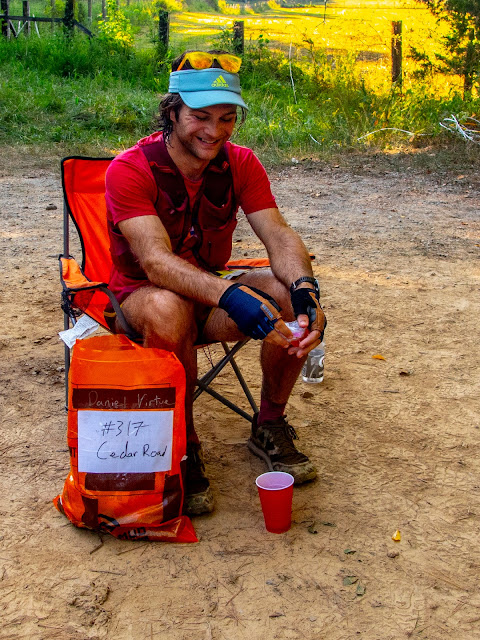
I was hoping the caffeine would give me a stronger boost, but it was limited. I wasn’t falling asleep, but I was sleepy. For a while, I played my music on my phone and would sing along, but it wasn’t long until I didn’t listen to anything and instead just focused on each step. I was dealing with more and more new pains appearing as I ran. The last was the sudden pain in my shin, which has been bothering me since the race, but is bothering me less now. I recorded a short video of each aid station, which was fun, and I was smiling a lot. I was on the last lap! No matter what, I was on the last lap, and I was going to finish! I cross the street, looking for the route to the finish, and then have to backtrack a bit. I was holding my poles and my phone when I heard the announcer say my name: “Daniel Virtue from St. Louis, Missouri.”
Lap 4
Lap Time: 7:35:47
Total Time: 26:31:34
Time of Day: 7:31 a.m.
Miles: 100.x
Lap Pace: 19 minutes and 33 seconds
Race Pace: 15 minutes and 55 seconds
Reviews of the Race for the Mohican 100
The Buckle
Rating: 4 stars
Personality: small but detailed
It shows two runners and a recreation of the road where the start/finish is. There are many visual references to aspects of the race that make this a unique buckle that makes you think about running the race. My only complaint is that it's smaller than my other buckles. It is the smallest regular buckle I have by at least 30 percent. The only smaller buckle I have is for running 100 miles in a 24-hour race.
Aid stations, Food, and Frequency
Rating: almost perfect
Personality: fast, reliable, and a decent variety
It can be tougher being vegan, but this race it was easy. There was always something I could eat and not just fruit and potato chips. They had hummus wraps and potato soup, and they were helpful and quick to refill bottles or get my drop bag. The frequency was perfect for the most part. There are two sections with over 6 miles between aid stations that felt a little long. I probably ran out of water earlier in the day, but that’s not too bad. When you switch to the short loop, you only have one long section like this.
The Course Markings
Rating: almost perfect
Personality: We have done this before
In general, excellent marking throughout the race. There is a lot of single track, but whenever there's a turn, signs and flags make it easy to know you’re going the right way. I might have looked at my watch one time to double-check that I was going the right way. The only complaint I have is with the sign that marks “short loop v. long loop.” The first two loops you do are long, so I mostly didn’t think about it. But in one section, I saw someone ahead of me and just went that way, but someone stopped me and directed me to go the other way because I was still doing the long loop. The next time through, I saw the sign pointing forward for short and left for long, but I thought someone would be directing, so I didn’t look for it. If you’re doing this for the first time, make sure you know where the split will be at each aid station so you get on the right loop. I know one guy who added 4 miles to his race because he did this.
The Weather
Rating: perfect
Personality: feels like spring
The temperature was ideal when I ran this race, and while it is not always that nice, it is early enough in the summer to offer temperatures in the 50s-60s. You might get some cooler temperatures overnight, you might get some rain with more stream crossings, but most years it is nice.
Terrain and Hills
Rating: 14 thousand feet of elevation and 2-3 difficult on the terrain
Personality: Not the toughest, but not easy
There were some tough sections, including one called the enchanted forest, but I would argue that most seasoned ultra runners won’t find many unique challenges in the terrain or hills in this race. It has some tough hills and sections with so many rocks and roots that running is difficult, but most of it is very runnable during the day; for me, it was harder at night. There were a handful of stream crossings and mud. My shoes got soaked a couple of times, and the mud was hard to navigate without getting both my legs caked in it.
Bugs and Animals
Rating: almost no bugs, but a lot of raccoons
Personality: Leave the Bug Spray at Home
In St. Louis, the bugs are insane, from all the mosquitoes to the ticks, wasps, and dragonflies. I have such unpleasant memories of dealing with hornets during the Shawnee Hill and the constant annoyance of the mosquitoes all summer in St. Louis, but they weren’t that bad during the Mohican. A big bee decided to live in my tent for a few days, but it was harmless. However, the raccoons were no joke, and one ripped a hole in my food bag. They ate the extra bread. It ended up not being a big deal, but I left it out for an hour during the day while I was at the information meeting on Friday night, so make sure to keep an eye on any food you bring to the race.
Sleeping Accommodations
Rating: Close to Perfection
Personality: It is Best to Camp
I stayed at Mohican Adventures Campground. The campground was quiet, clean, and had plenty of bathrooms, and the showers weren’t too far away. It came off a little old school, but the best part of the campground was how close it was to the race. I was about .15 miles from the start/finish. This improved so many aspects of the race. I could easily walk to the packet pickup, the race meeting, and the race start in the morning. I was able to sleep until 4 a.m. for the 5 a.m. start and had enough time to set up my self-supported aid area, eat breakfast, and get ready for the race. There are at least two other campgrounds nearby, so I would pick one if I were doing this race. If you don’t like to camp, they also have log cabins. You could stay in a hotel or rent a house, but you’re looking at a 30-minute drive.
After I finished the race, I took a nap in my tent, then returned to pick up my drop bag from the Covered Bridge Aid station. When I got there, I decided to sit and watch some of the other runners finish. It was something I have always wanted to do, but usually I have already left. This time, because I was able to camp so close, I suddenly had so much more time.
Race Packet
Rating: Does the Job
Personality: Not Showing Off
This packet doesn’t need to offer any stinkin’ swag like samples of products that I have never heard of, nor does it bother to provide information about the community or the parks, or have stickers that we will put in a drawer and forget about. It is one recycled plastic grocery bag with the race bib and the t-shirt. The t-shirt feels soft, and the colors work beautifully; it is a nice, simple design.





Comments
Post a Comment